

Mount St. Mary’s University was awarded a $10,000 grant from the G. Frank Thomas Foundation to support two students from Frederick County for the School of Science, Mathematics & Technology’s Summer Scholars Research Program. Sameera Ashfaq, C’27, and Lulu Sanchez-Chagoya, C’27, were awarded the funds and conducted research this summer under the mentorship of Mount faculty.
“We are grateful to the G. Frank Thomas Foundation for partnering with us to create powerful professional development opportunities for Mount students from Frederick County,” said Dean of the School of Science, Mathematics & Technology and Professor of Biochemistry Christine McCauslin, Ph.D., who co-wrote the grant with Associate Professor of Biochemistry Michael J. Turner, Ph.D. “The Foundation’s financial support enables these students to participate in immersive research opportunities that challenged them to think in new ways, develop problem solving skills, and build resilience as part of their scientific journey.”
The Summer Scholars Research Program provides direct experiential education through paid, immersive summer research experiences by creating opportunities for early engagement with mentored laboratory research, a high impact practice shown to improve retention and completion of students pursuing STEM degrees.
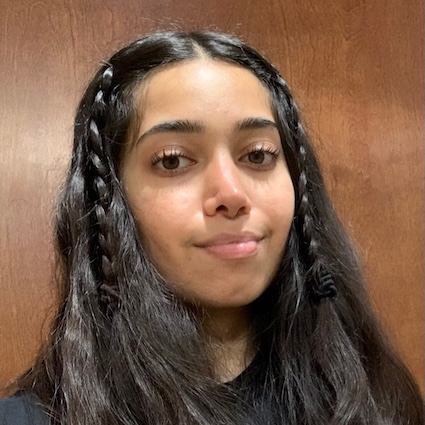
Ashfaq, C’27, a biochemistry major, spent her summer conducting laboratory research focused on HIV. She was mentored by Assistant Professor of Biology Geraldine Vilmen, Ph.D., and investigated how the body may help break down HIV’s envelope protein, a critical component that allows the virus to infect human cells. Ashfaq’s project specifically explored whether autophagy, the body’s natural recycling process, plays a role in a pathway involving the protein MARCH8 that may contribute to HIV envelope degradation.
Although some experiments did not work as planned, she gained valuable experience troubleshooting problems, learning new research methods, and developing critical thinking skills. She also learned techniques including cell culture, bacterial transformation, enzymatic digestion, DNA ligation, gel electrophoresis, and DNA extraction/purification.
“Something I learned about myself this summer is that I really enjoy doing research,” she said. “I think it’s one of the coolest things in the world—being able to work toward understanding and solving problems through intriguing experiments.”
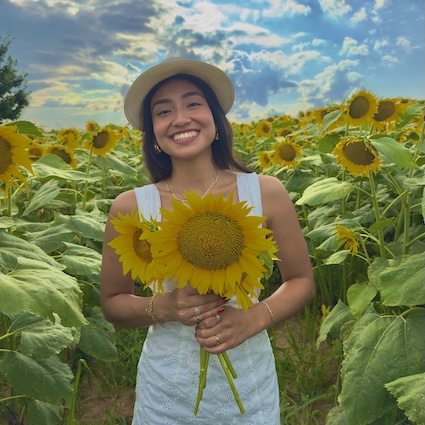
Just down the hallway in the Coad Science Building, Sanchez-Chagoya, C’27, a biology major, was excited to experience research outside of the classroom. “When the opportunity arose, I was motivated by the potential outcomes and obstacles I would encounter through the experiment process,” she said. Her environmental science research looked at how cyanobacteria, a type of algae, responds to different environmental conditions, including metal-rich environments. Inspired by her own family’s appreciation for nature and the environment, Sanchez-Chargoya explored how environmental stress may influence cyanobacteria growth and bloom formation.
Alongside her mentor, Assistant Professor of Science Rachel Hartnett, Ph.D., she developed several hands-on laboratory skills including accurate pipetting, measuring and monitoring algae growth levels, preparing media, maintaining sterile technique, culturing cyanobacteria, and recording data systematically.
Similarly to Ashfaq, she encountered setbacks which she says led her to adapt quickly and remain open to unexpected outcomes. When she discovered a revived algae culture turned out to be a different species, likely a previous contaminant that took over, she turned the challenge into a learning opportunity. This culture still was sensitive to metal-rich environments compared to the others.
“This process showed me that I’m capable of handling challenges and that I thrive in environments where curiosity and persistence are essential,” she added.
Both students shared their research through poster presentations at the Mount’s annual Research Quality Undergraduate Experience in Science and Technology, or QUEST, an event that provides students with valuable opportunities to engage in faculty-led research and internships, helping them build the knowledge, skills, and professional experience needed for graduate studies and future STEM careers. More than two dozen student researchers and mentors from the Departments of Science, Mathematics and Computer Science, and Psychology joined the showcase.
Ryan Baugher, Ph.D., a Director of the G. Frank Thomas Foundation, attended the event. “The amount these students achieved in one summer was amazing to see, and our foundation is so happy to have been able to contribute to the growth of the next generation of our community’s scientific talent. Learning about how Lulu’s and Sameera’s research experience showed them a new side of the field really highlighted what experiences like these are meant for.”
The G. Frank Thomas Foundation has been a Frederick County, Maryland institution for over 70 years—keeping it in the community since 1954 when George Franklin Thomas incorporated the nonprofit private foundation. Born in Adamstown in 1886, Thomas’ passion for farming combined with his entrepreneurial spirit led to the creation of Adamstown Canning and Supply Company, the Frederick Trading Company, and several other canning organizations along the now I-270 corridor.
Seven decades later, the board members of the G. Frank Thomas Foundation still strive to keep his mission alive by working with other nonprofits that truly stand as pillars of their communities and support systems for Frederick County neighbors. The G. Frank Thomas Foundation has worked with more than 40 nonprofits in the local community and awarded well over 300 grants.
McCauslin added, “We are proud to play a small part in the legacy of G. Frank Thomas to invest in our local community.”